

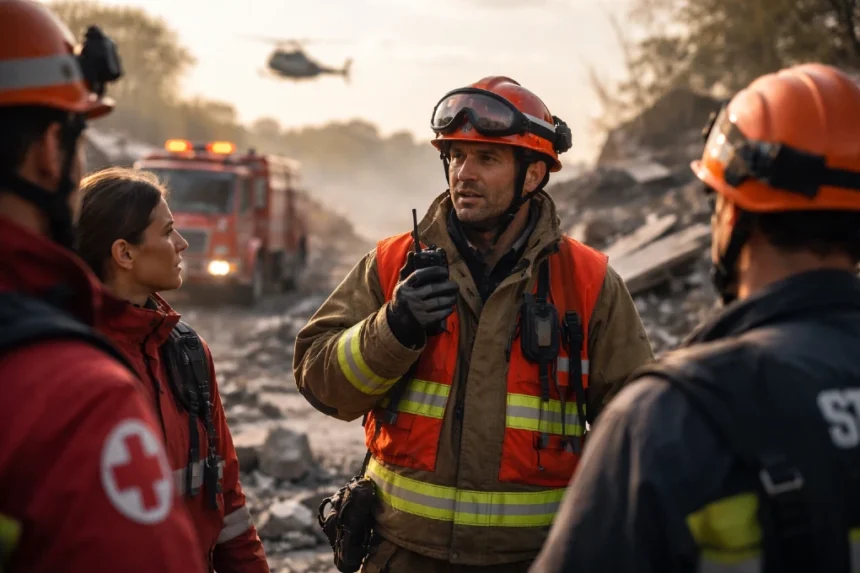
When people ask, How Can We Empower the Disaster Management Crew, they are really asking a bigger question about resilience, leadership, and public safety. In a crisis, disaster crews are the difference between confusion and coordination, panic and protection, loss and survival. They step into floods, earthquakes, fires, storms, industrial accidents, disease outbreaks, and humanitarian emergencies when most people are trying to get to safety.
- Why disaster management crews need real empowerment
- How Can We Empower the Disaster Management Crew through training and preparedness
- Technology can strengthen response when it is usable
- Better leadership and faster decision making save time
- Mental health support is operational support
- Community support makes crews more effective
- Funding must move from reactive to strategic
- Inclusion improves outcomes on the ground
- A simple crisis scenario that shows the difference
- Common questions readers ask
- Final thoughts
That is why empowering them cannot be treated as an afterthought. It has to be part of planning long before a disaster strikes. Better training, stronger communication systems, practical mental health support, safer equipment, and faster decision making all shape how well a response team performs under pressure. Global evidence also shows why this matters. The World Meteorological Organization reports that weather, climate, and water related hazards caused more than 2 million deaths and US$4.3 trillion in economic losses between 1970 and 2019.
A disaster response team does not need praise alone. It needs resources, trust, structure, and sustained support. When communities and institutions invest in the people on the front lines, outcomes improve. Response becomes faster, coordination becomes cleaner, and more lives can be protected.
Why disaster management crews need real empowerment
Disaster management crews operate in high pressure environments where every minute matters. They often work across multiple agencies, under changing weather conditions, with limited visibility and incomplete information. FEMA notes that the National Incident Management System is built to help government, nongovernmental organizations, and the private sector work together across incidents, while its Incident Command System is designed to integrate personnel, procedures, equipment, and communications within a common structure.
That tells us something important. Empowerment is not just about motivation. It is about giving crews the authority, tools, and systems needed to act effectively.
A team may include firefighters, paramedics, civil defense units, emergency planners, public health staff, engineers, logistics specialists, volunteers, and communications officers. If even one part of that chain is weak, the overall response slows down.
What empowerment looks like in practice
Empowerment means crews have:
- Clear command structures
- Up to date training
- Reliable communication tools
- Access to risk maps and real time data
- Protective gear and medical support
- Mental health resources
- Community trust and cooperation
- Enough staffing and backup capacity
- Strong leadership with local autonomy
Without these basics, even experienced responders can become overwhelmed.
How Can We Empower the Disaster Management Crew through training and preparedness
The most direct answer to How Can We Empower the Disaster Management Crew is preparation. Teams perform better when they train for the exact conditions they may face in the real world. That includes not only technical drills, but also scenario based exercises that simulate pressure, uncertainty, communication breakdowns, and multi agency coordination.
FEMA states that NIMS training helps mitigate risk by improving preparedness and by facilitating training and qualification in core emergency management concepts. IFRC also maintains structured learning opportunities and training resources for volunteers and responders, recognizing that learning must be continuous, practical, and scalable.
Training should cover:
- Incident command and role clarity
- Search and rescue operations
- Triage and field medical response
- Hazard identification
- Evacuation planning
- Communication protocols
- Working with volunteers and local leaders
- Psychological first aid
- Digital mapping and data tools
- After action review methods
Training also needs to be local. A coastal city faces different threats than a mountainous region or a dense urban center. Empowerment grows when training reflects real geography, local infrastructure, and cultural realities.
Technology can strengthen response when it is usable
Technology is often praised during emergencies, but not every tool helps in the field. The best systems are the ones crews can use quickly, reliably, and under stress. That includes radio interoperability, emergency broadband, geolocation, drone support, digital checklists, shared maps, and alert platforms.
NIST emphasizes that public safety communications research focuses on interoperability and information sharing across agencies, while FEMA’s Disaster Emergency Communications unit exists specifically to support telecommunications and the survivability and interoperability of emergency communication systems.
Practical technologies that empower crews
| Need | Helpful solution | Why it matters |
|---|---|---|
| Multi agency coordination | Interoperable radio and data systems | Reduces confusion across teams |
| Field visibility | Drones and live mapping | Improves situational awareness |
| Resource tracking | Logistics dashboards | Prevents shortages and duplication |
| Public alerts | Mobile warning systems | Helps communities act faster |
| Responder safety | Location tracking and wearables | Speeds rescue if a responder is injured |
| Documentation | Mobile incident reporting | Improves accountability and review |
Still, technology only works when responders are trained to use it. An expensive system that fails in a storm, loses signal, or overwhelms a team with bad data does more harm than good.
Better leadership and faster decision making save time
One of the most overlooked parts of emergency management is decision quality. Crews need leaders who can simplify complexity, delegate clearly, and adjust plans in real time. They also need enough authority at the local level to act without waiting for slow approvals during life threatening situations.
Empowerment grows when leaders:
- Communicate priorities clearly
- Share information honestly
- Trust trained personnel to make field decisions
- Encourage feedback from the ground
- Review mistakes without blame
- Build cross agency relationships before disasters happen
This matters because disaster response is rarely linear. Conditions shift. Roads close. Weather changes. Shelters fill up. Supplies run short. The strongest crews are not just disciplined. They are adaptive.
Mental health support is operational support
A disaster crew cannot keep performing at a high level if burnout, trauma, and exhaustion are ignored. WHO has highlighted the need for structured mechanisms, debriefing, and accessible mental health services for emergency responders. WHO also states that in emergencies, nearly all affected people experience psychological distress, and about one in five may develop a mental health condition.
While those figures refer broadly to emergency affected populations, responders are also repeatedly exposed to trauma, grief, uncertainty, and sleep deprivation. That makes mental health support an operational necessity, not a soft add on.
What strong mental health support includes
- Pre incident resilience training
- Scheduled rest cycles during deployment
- Peer support systems
- Access to confidential counseling
- Structured debriefing after major incidents
- Supervisor training to identify stress overload
- Family support pathways for responders
When crews feel psychologically supported, absenteeism drops, performance improves, and turnover can be reduced. Teams also become more stable over time, which strengthens institutional memory and long term readiness.
Community support makes crews more effective
No disaster management crew can work alone. Public cooperation changes everything. Communities that understand evacuation routes, emergency alerts, shelter systems, and local hazards are easier to protect in a crisis. Ready.gov consistently emphasizes planning, emergency alerts, communication plans, and household readiness because preparedness at the community level reduces avoidable pressure during emergencies.
This means empowering crews also requires educating the public.
Communities can support disaster teams by:
- Following official instructions quickly
- Avoiding rumor sharing and misinformation
- Learning local evacuation plans
- Keeping emergency kits ready
- Joining volunteer training programs
- Respecting restricted zones
- Donating through verified channels
- Checking on vulnerable neighbors
When the public is informed, response teams spend less time correcting panic and more time protecting people who need immediate help.
Funding must move from reactive to strategic
Many regions spend heavily after disasters and too little before them. That is a costly pattern. Empowerment means investing in readiness before the headlines appear. UNDRR continues to stress the value of risk informed systems and national disaster risk reduction strategies, while its 2024 annual report notes that only a little more than half of countries report having a life saving early warning system.
That gap matters. If warnings arrive late, response crews carry a heavier burden. If infrastructure is weak, rescue becomes harder. If staffing is thin, fatigue rises. Strategic investment helps reduce those failures before the next crisis begins.
Smart investments include:
- Early warning systems
- Emergency operations centers
- Local stockpiles of essential equipment
- Communication upgrades
- Continuous training budgets
- Volunteer management systems
- Mental health and recovery support
- Hazard mapping and data analysis
Empowered crews are built through budgets, not slogans.
Inclusion improves outcomes on the ground
Disasters affect people differently. Older adults, children, people with disabilities, low income households, rural communities, migrants, and those with chronic health conditions often face higher risk. Teams are more effective when they are trained to plan for these differences rather than treating everyone the same.
Inclusive empowerment means:
- Accessible evacuation planning
- Multilingual alerts
- Disability inclusive shelter design
- Gender sensitive safety measures
- Community liaison roles
- Local volunteer networks
- Partnerships with health and social care providers
A crew that understands vulnerability can respond more precisely. That precision saves time and reduces harm.
A simple crisis scenario that shows the difference
Imagine a coastal district hit by severe flooding after days of extreme rain. In one version of the story, the local disaster team has weak radio coverage, no updated hazard maps, poor rest scheduling, and little public trust. Evacuation orders are delayed. Roads become gridlocked. Confusion spreads online. Crews arrive, but coordination breaks down.
Now imagine the same district with better preparation. The crew trained together months earlier. Agencies share a communication platform. Local leaders help spread verified alerts. Volunteers know how to support shelters. Responders rotate on defined rest cycles. Critical equipment is already staged.
Both districts face the same storm. The difference is empowerment.
Common questions readers ask
Why is disaster crew empowerment so important?
Because responders make life saving decisions in unstable conditions. Better support helps them act faster, safer, and more accurately.
What is the biggest barrier to effective disaster response?
It is rarely one single issue. Common barriers include weak coordination, outdated equipment, poor communication systems, limited training, and responder fatigue.
Does technology solve most disaster response problems?
No. Technology helps when it improves communication, visibility, and coordination. It fails when it is poorly integrated, unreliable, or unfamiliar to field teams.
Should volunteers be part of disaster management?
Yes, but they need structure, training, and supervision. IFRC’s learning and volunteer programs reflect how organized volunteer engagement can support formal response systems.
Final thoughts
The real answer to How Can We Empower the Disaster Management Crew is not complicated, but it does require commitment. Train them well. Equip them properly. Protect their mental health. Strengthen communication. Fund preparedness. Build trust with communities. Give leaders the systems and authority to act quickly. Review every crisis honestly and improve the next response before the next emergency arrives.
If governments, institutions, nonprofits, and communities take those steps seriously, disaster teams will not just respond to crises. They will respond with greater speed, confidence, coordination, and care. That is how lives are protected when conditions are at their worst.
Strong public safety starts long before the sirens. It starts with investment, planning, and shared responsibility. In that sense, empowering the crew is also about empowering the whole system of disaster preparedness that surrounds them.