


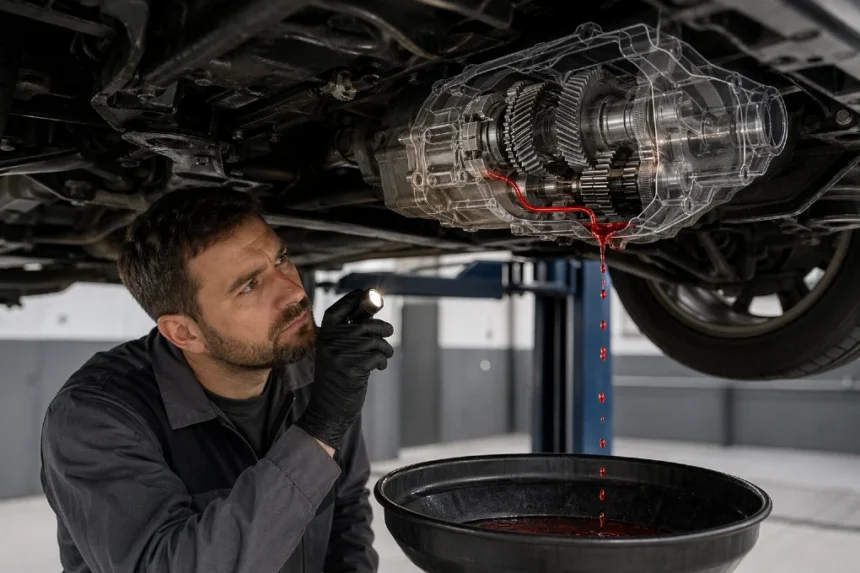
A Gearbox Leaking Fluid problem is one of those car issues that can look small at first but turn expensive fast. You may notice a red, pink, brown, or oily patch under your vehicle and wonder if it is serious enough to stop driving. In many cases, yes, it deserves quick attention because gearbox fluid helps lubricate, cool, and protect the transmission while it shifts power from the engine to the wheels.
- What Does Gearbox Fluid Actually Do?
- Gearbox Leaking Fluid Signs You Should Notice Early
- Main Reasons Your Transmission Is Dripping
- 1. Worn Transmission Pan Gasket
- 2. Loose or Damaged Transmission Pan
- 3. Cracked or Worn Seals
- 4. Damaged Transmission Cooler Lines
- 5. Faulty Drain Plug or Fill Plug
- 6. Overfilled Transmission Fluid
- 7. Transmission Vent Problems
- 8. Worn Torque Converter Seal
- 9. Axle Seal Leaks on Front-Wheel-Drive Cars
- 10. Old or Contaminated Fluid
- How to Tell If It Is Transmission Fluid or Something Else
- Is It Safe to Drive With Gearbox Leaking Fluid?
- What to Check First at Home
- Common Repair Options
- Should You Use Transmission Stop Leak?
- Real-World Example: The Small Drip That Became a Big Bill
- How to Prevent Gearbox Fluid Leaks
- When to Call a Mechanic Immediately
- FAQs About Gearbox Leaking Fluid
- What color is gearbox fluid when it leaks?
- Can low gearbox fluid cause slipping?
- Why is my gearbox leaking only when parked?
- How much does it cost to fix a transmission leak?
- Can I just top off the transmission fluid?
- Conclusion
The tricky part is that a transmission leak does not always start with a dramatic puddle. Sometimes it begins as a few drops on the driveway, a faint burning smell, or slightly rough gear changes. If you catch it early, the fix may be simple. If you ignore it, the gearbox can overheat, slip, grind, or suffer internal damage.
What Does Gearbox Fluid Actually Do?
Gearbox fluid is not just “oil inside the transmission.” It has several jobs at once.
In an automatic transmission, the fluid helps transfer power, lubricates moving parts, keeps temperatures under control, and supports smooth gear shifts. In a manual transmission, gear oil mainly reduces friction between gears, bearings, and shafts.
When a leak lowers the fluid level, the gearbox has to work harder with less protection. That is when heat builds up, metal parts wear faster, and shifting can start to feel strange.
A Gearbox Leaking Fluid issue should never be treated like a harmless stain. Transmission fluid is part of the system that keeps your car moving correctly.
Gearbox Leaking Fluid Signs You Should Notice Early
Many drivers first spot the problem after parking their car overnight. A small wet patch under the middle or front section of the vehicle can be the first clue.
Common signs include:
- Red, pink, amber, or brown fluid under the car
- Burning smell after driving
- Rough or delayed gear shifts
- Gear slipping during acceleration
- Transmission warning light or check engine light
- Low fluid level on the dipstick, if your vehicle has one
- Humming, whining, or grinding noises
- Car hesitating before moving from a stop
Fresh automatic transmission fluid is often red or pink, while older fluid may appear brown or darker. Several auto repair sources note that visible reddish or brownish fluid under the car, delayed shifting, slipping gears, and low transmission fluid levels are common warning signs of a transmission leak.
If your car is leaving puddles and also shifting badly, do not keep driving as if nothing is wrong. A Gearbox Leaking Fluid problem can quickly move from a minor seal issue to major transmission damage.
Main Reasons Your Transmission Is Dripping
There is no single cause behind every transmission leak. The leak may come from a gasket, seal, pan, plug, cooler line, or even the torque converter.
Here are the most common reasons behind a Gearbox Leaking Fluid situation.
1. Worn Transmission Pan Gasket
The transmission pan gasket is one of the most common leak points. It sits between the transmission pan and the transmission body, creating a seal that keeps fluid inside.
Over time, this gasket can shrink, crack, harden, or lose its sealing ability. Heat makes the problem worse. Road dirt, old fluid, poor installation, or age can also speed up wear.
You may notice fluid collecting around the edge of the pan. If the leak is slow, it may only drip after the car has been parked for a while.
This is often one of the less expensive repairs compared with internal transmission work. Still, ignoring it can drain the gearbox slowly until shifting problems begin.
2. Loose or Damaged Transmission Pan
The transmission pan itself can also be the reason for a Gearbox Leaking Fluid issue. This metal pan holds fluid at the bottom of many automatic transmissions.
Because it sits low under the vehicle, it can get hit by road debris, rocks, speed bumps, or rough ground. Even a small dent near the sealing surface can stop the gasket from sitting flat.
Pan bolts can also loosen over time. Sometimes, after a fluid service, bolts may be tightened unevenly or too tightly. That can distort the pan or damage the gasket.
A damaged pan may leak slowly at first, then suddenly get worse after another impact.
3. Cracked or Worn Seals
Gearboxes use several seals to keep fluid inside while allowing rotating parts to move. These seals are usually made from rubber or similar materials.
Common leak points include:
- Input shaft seal
- Output shaft seal
- Axle seals
- Selector shaft seal
- Torque converter seal
Seals deal with heat, pressure, vibration, and constant movement. Over time, they become hard or brittle. Once that happens, fluid can escape around the shaft.
A seal leak may show up as fluid near the front, side, or rear of the transmission. The exact location depends on the vehicle layout.
Broken seals, damaged pans, failing gaskets, cracked fluid lines, and torque converter problems are widely listed by repair specialists as common causes of transmission fluid leaks.
4. Damaged Transmission Cooler Lines
Automatic transmissions often send fluid through cooler lines to help manage temperature. These lines may run from the transmission to a cooler built into the radiator or a separate transmission cooler.
Cooler lines can leak for several reasons:
- Rust or corrosion
- Road debris damage
- Loose fittings
- Cracked rubber sections
- Heat-related wear
- Poor previous repairs
A cooler line leak can be serious because fluid may escape faster than it would from a small gasket seep. If a line bursts, the transmission can lose fluid quickly.
This type of Gearbox Leaking Fluid problem may leave streaks or wet areas along the underbody instead of one neat puddle.
5. Faulty Drain Plug or Fill Plug
Some gearboxes have drain and fill plugs. These plugs must be tightened correctly and sealed properly.
A leak can happen when:
- The plug is loose
- The washer is worn
- The threads are damaged
- The plug was overtightened
- The wrong washer was used
This issue often appears after recent maintenance. If the leak began soon after a transmission fluid change, the drain plug or fill plug should be checked first.
A small drip from a plug may seem harmless, but it can still lower the fluid level over time.
6. Overfilled Transmission Fluid
Many people assume low fluid is the only problem. Too much fluid can also create trouble.
When a transmission is overfilled, the fluid may foam, expand, or build pressure. That pressure can push fluid out through vents, seals, or weak areas.
This can make it look like a Gearbox Leaking Fluid problem even when the original issue was incorrect fluid level.
Overfilling often happens during DIY maintenance or when fluid is checked incorrectly. Some vehicles must be checked at a specific temperature, while running, and on level ground. Always follow the correct procedure for your car.
7. Transmission Vent Problems
Gearboxes need a way to release pressure. That is where the transmission vent comes in.
If the vent becomes clogged with dirt or debris, pressure can build inside the gearbox. When pressure has nowhere to go, fluid may be forced past seals or out of weak points.
A blocked vent can be hard to diagnose because the seals may look like the problem. But replacing seals without fixing the vent can lead to another leak later.
This is why a proper inspection matters. A good technician does not just clean the leak and replace the nearest gasket. They look for the reason pressure or fluid escaped in the first place.
8. Worn Torque Converter Seal
In automatic vehicles, the torque converter sits between the engine and transmission. It uses fluid to transfer power smoothly.
A leak near the bell housing area may point to a torque converter seal or front pump seal issue. This is usually more labor-intensive than a simple pan gasket repair because the transmission may need to be removed for access.
Symptoms can include:
- Fluid dripping between engine and transmission
- Shuddering while accelerating
- Low fluid level
- Burning smell
- Delayed engagement when shifting into drive or reverse
A Gearbox Leaking Fluid problem from this area should be inspected quickly. The leak may worsen and affect drivability.
9. Axle Seal Leaks on Front-Wheel-Drive Cars
Many front-wheel-drive cars use axle shafts connected directly to the transmission. The axle seals keep fluid from leaking where the axles enter the gearbox.
If an axle seal wears out, fluid may drip near one side of the transmission. Sometimes the leak appears after axle replacement, suspension work, or hitting a pothole.
A bad axle seal can leave fluid on nearby suspension parts, making the leak harder to trace. The repair usually involves removing the axle and replacing the seal.
If ignored, the leak can lower the fluid level enough to cause transmission noise or shifting problems.
10. Old or Contaminated Fluid
Old transmission fluid may not directly “create” a hole, but it can contribute to problems. As fluid ages, it loses some of its protective qualities. It can also carry debris that affects seals, valves, and internal passages.
Dirty fluid may increase heat and wear, which can weaken gaskets and seals over time. If the fluid smells burnt or looks very dark, that is a sign the transmission has been running hot or under stress.
A Gearbox Leaking Fluid issue with burnt-smelling fluid should be handled carefully. Simply topping it off may not solve the deeper problem.
How to Tell If It Is Transmission Fluid or Something Else
Cars use several fluids, and leaks can look confusing. Transmission fluid is often red or pink when fresh, but color alone is not always enough.
Here is a simple comparison:
| Fluid Type | Common Color | Typical Location | Common Clue |
|---|---|---|---|
| Transmission fluid | Red, pink, amber, brown | Center or front-middle under car | Slippery feel, shifting issues |
| Engine oil | Brown or black | Under engine | Oily smell, oil level drops |
| Coolant | Green, orange, pink, yellow | Front area | Sweet smell, overheating |
| Brake fluid | Clear to amber | Near wheels or brake lines | Soft brake pedal |
| Power steering fluid | Red, amber, brown | Front engine area | Steering noise |
If the fluid is red or brown and the car is shifting poorly, a transmission leak is likely. But it is still wise to confirm before adding any fluid. Using the wrong fluid can damage the system.
Is It Safe to Drive With Gearbox Leaking Fluid?
It depends on how bad the leak is, but driving with a Gearbox Leaking Fluid problem is risky.
If you see a few drops and the car shifts normally, you may be able to drive a short distance to a repair shop. If there is a large puddle, slipping gears, a burning smell, or delayed engagement, avoid driving.
Low transmission fluid can cause:
- Overheating
- Clutch wear
- Gear slipping
- Harsh shifting
- Internal metal damage
- Complete transmission failure
Many repair professionals warn that transmission leaks should be addressed quickly because the fluid supports lubrication, cooling, and shifting function, and low levels can lead to expensive damage.
A good rule is simple. If the car feels different when shifting, do not push your luck.
What to Check First at Home
You do not need to be a mechanic to do a basic inspection. Just be safe and do not crawl under a car supported only by a jack.
Start with these checks:
- Look at the color of the fluid on the ground.
- Note where the puddle is located.
- Check whether the leak appears after driving or after parking overnight.
- Look for stains around the transmission pan.
- Check the fluid level if your vehicle has a dipstick.
- Pay attention to shifting behavior.
- Notice any burning smell after driving.
Place clean cardboard under the vehicle overnight. This helps you see the drip location more clearly.
If the leak is near the center of the car, it may be the transmission pan or gasket. If it is closer to one side, it may be an axle seal. If it is near the front, cooler lines may be involved.
Common Repair Options
The correct repair depends on the leak source. There is no universal fix for every Gearbox Leaking Fluid problem.
Possible repairs include:
- Replacing the pan gasket
- Tightening or replacing pan bolts
- Replacing a damaged transmission pan
- Installing a new drain plug washer
- Replacing axle seals
- Replacing cooler lines
- Fixing or replacing shaft seals
- Repairing the torque converter seal
- Correcting overfilled fluid
- Cleaning or repairing the transmission vent
Some leaks are easy to repair. Others require removing major parts. That is why diagnosis matters more than guessing.
Should You Use Transmission Stop Leak?
Transmission stop leak products are popular because they seem quick and cheap. Sometimes they may soften old seals slightly and slow a small seep.
But they are not a real fix for:
- Cracked metal lines
- Damaged pans
- Loose plugs
- Torn gaskets
- Major seal failure
- Torque converter leaks
Stop leak products can also cause concerns in sensitive modern transmissions. If your vehicle has a CVT, dual-clutch transmission, or newer sealed transmission, be extra cautious.
For a small old-seal seep on an older vehicle, a stop leak may buy time. For an active drip or puddle, proper repair is the safer choice.
Real-World Example: The Small Drip That Became a Big Bill
Imagine a driver notices three small red spots under the car every morning. The car still drives fine, so they ignore it.
Two weeks later, the transmission starts hesitating before shifting into drive. A few days after that, it slips while merging onto the highway. By the time the vehicle reaches the shop, the fluid is low and smells burnt.
The original issue was a pan gasket. The early repair would have been simple. Waiting allowed heat and low fluid pressure to damage internal parts.
That is the danger of a Gearbox Leaking Fluid problem. The leak itself may be cheap, but the damage caused by low fluid may not be.
How to Prevent Gearbox Fluid Leaks
You cannot prevent every leak, but good habits reduce the risk.
Here are practical tips:
- Service transmission fluid at the interval recommended for your vehicle.
- Use the exact fluid type required by the manufacturer.
- Avoid rough driving over rocks, curbs, and debris.
- Check for leaks after transmission service.
- Do not ignore burnt smells or rough shifts.
- Fix small leaks before they become large ones.
- Keep the underside clean enough to notice fresh fluid.
- Have cooler lines inspected on older vehicles.
If your car tows, drives in heavy traffic, climbs hills often, or operates in hot weather, the transmission works harder. In those cases, regular inspection is even more important.
When to Call a Mechanic Immediately
Some signs mean the vehicle should be inspected right away.
Call a mechanic if you notice:
- A large puddle under the car
- Gear slipping
- Car refusing to move
- Burning smell
- Grinding or whining noises
- Transmission warning light
- Fluid dripping fast
- Dark, burnt-smelling fluid
A Gearbox Leaking Fluid issue with these symptoms can turn serious quickly. Driving farther may increase repair costs.
FAQs About Gearbox Leaking Fluid
What color is gearbox fluid when it leaks?
Automatic transmission fluid is often red or pink when fresh. It may become brown or dark as it ages. Manual gearbox oil can look amber, brown, or dark and may have a strong smell.
Can low gearbox fluid cause slipping?
Yes. Low fluid can reduce hydraulic pressure in an automatic transmission. That can cause slipping, delayed shifting, rough engagement, or overheating.
Why is my gearbox leaking only when parked?
A leak may appear when parked because fluid settles in the pan and slowly escapes through a gasket, seal, drain plug, or cracked pan. Heat expansion after driving can also make leaks more noticeable.
How much does it cost to fix a transmission leak?
The cost depends on the cause. A pan gasket or drain plug washer may be relatively affordable. A front seal, torque converter seal, or internal leak can cost much more because labor time is higher.
Can I just top off the transmission fluid?
Topping off may help temporarily if the level is low, but it does not fix the leak. You also need the correct fluid type and correct filling procedure. Overfilling can create more problems.
Conclusion
A Gearbox Leaking Fluid problem is not something to ignore, even if the car still drives normally. The leak may come from a worn gasket, damaged pan, cracked cooler line, loose plug, old seal, blocked vent, or torque converter area. Some repairs are simple, but waiting too long can lead to overheating, slipping, and costly transmission damage.
The smart move is to identify the fluid, check how fast it is leaking, and get the source repaired before the gearbox runs low. Your transmission is a complex system built around moving gears, seals, pressure, and fluid flow. Even a small leak can affect the way the whole gear set works if the fluid level drops too far.
If you notice Gearbox Leaking Fluid, treat it as an early warning. A quick inspection today can save you from a much bigger repair tomorrow.