


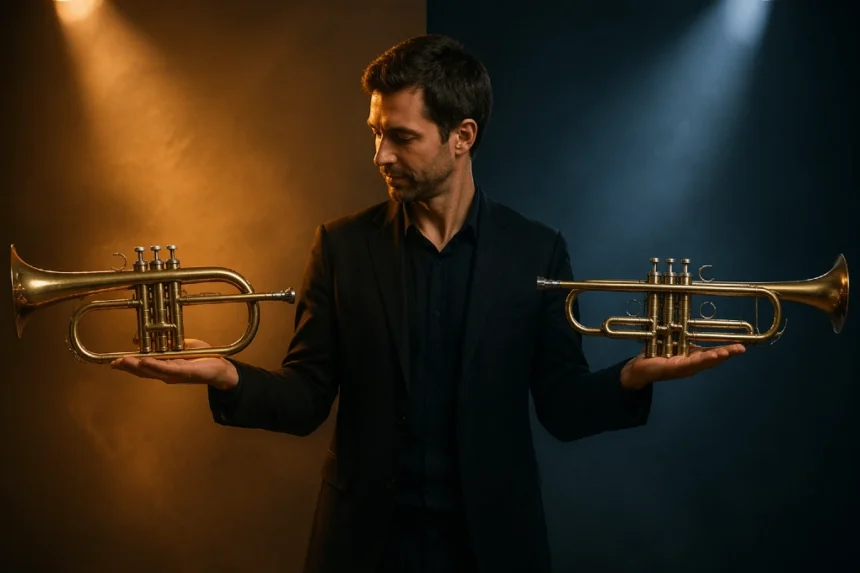
If you have ever heard two brass players perform the same melody and felt that one sounded bright and brilliant while the other felt warmer and more lyrical, you were probably hearing the difference between a trumpet and a Flugelhorn. These instruments look related because they are, but they do not behave the same way in real playing situations. Their shape, response, mouthpiece design, and musical role all push players toward different kinds of sound and expression.
- What Is the Main Difference Between a Flugelhorn and a Trumpet?
- Why the Flugelhorn Sounds Warmer
- Trumpet Tone vs Flugelhorn Tone in Actual Music
- Flugelhorn vs Trumpet Design Differences
- Is the Flugelhorn Harder to Play Than a Trumpet?
- Which Instrument Is Better for Beginners?
- When Should You Use a Flugelhorn Instead of a Trumpet?
- Flugelhorn in Jazz, Brass Band, and Concert Music
- Common Mistakes Players Make When Switching to Flugelhorn
- How to Choose Between a Trumpet and a Flugelhorn
- Final Thoughts on Flugelhorn vs Trumpet
- Conclusion
The Flugelhorn is often described as softer, rounder, and more mellow than a trumpet. That description is accurate, but it is also incomplete. The real difference is not just that one is brighter and one is darker. It is that each instrument naturally encourages a different musical personality. A trumpet projects, cuts through ensembles, and delivers clarity in lead lines. A Flugelhorn blends more easily, wraps notes in a gentler texture, and tends to reward phrasing that feels vocal rather than aggressive.
For players, band directors, students, arrangers, and curious listeners, knowing when to choose one over the other matters. It affects tone color, endurance, repertoire choices, and even how an audience emotionally receives a piece of music. This is why the comparison between trumpet and Flugelhorn keeps coming up in jazz, brass bands, studio work, and music education.
What Is the Main Difference Between a Flugelhorn and a Trumpet?
The simplest answer is this: the trumpet is built for brilliance and projection, while the Flugelhorn is built for warmth and breadth of tone. Much of that comes from bore design and mouthpiece shape. The Flugelhorn has a wider, more conical bore, while the trumpet relies more heavily on a cylindrical design. That physical difference changes how air moves through the instrument and helps explain why the two instruments feel and sound so distinct.
Most flugelhorns are pitched in B-flat, just like many trumpets, and both instruments commonly use three valves. Because the fingering system is familiar, many trumpet players can pick up a Flugelhorn without learning a whole new layout. But that does not mean the transition is automatic. The response, resistance, articulation, slotting, and phrasing approach can feel different enough that serious players treat the Flugelhorn as its own voice rather than just a trumpet alternative.
In real-world terms, the trumpet says, “Listen here.” The Flugelhorn says, “Come closer.”
Why the Flugelhorn Sounds Warmer
The sound of a Flugelhorn is strongly tied to its conical design and deeper mouthpiece style. Yamaha notes that the trumpet is known for volume, upper-register ability, and a bright tone, while the flugelhorn is associated with a mellower sound. Britannica also describes the flugelhorn as a valved brass instrument with a wider bore than closely related brass voices, which supports that fuller tonal identity.
That warmth is the reason the Flugelhorn appears so often in lyrical jazz passages, ballads, brass band textures, and moments where the composer or arranger wants emotional softness without losing brass character. It still has presence, of course, but it does not usually speak with the same laser-focused edge as a trumpet.
Players often notice the difference most clearly on sustained notes. A trumpet tends to put a defined center on the note quickly. A Flugelhorn often lets the note bloom more gradually. That can make phrases feel more intimate and singing, especially in slower music.
Trumpet Tone vs Flugelhorn Tone in Actual Music
Trumpet tone is brilliant, direct, clear, and penetrating. It is ideal for fanfares, lead parts, orchestral accents, big-band section work, and any musical setting where projection matters. Even listeners with no technical background often recognize the trumpet immediately because its sound carries so well and retains definition at a distance.
Flugelhorn tone is broader, darker, softer at the edge, and often described as velvety. In jazz, it is favored when a solo needs to feel more conversational or reflective. In ensemble writing, it can bridge the gap between brighter brass and warmer middle voices. That makes the Flugelhorn especially valuable in textures where blend matters more than sheer cut.
A useful way to think about it is this:
| Feature | Trumpet | Flugelhorn |
|---|---|---|
| Core tone | Bright and focused | Warm and round |
| Projection | Strong and cutting | Softer and broader |
| Best for | Fanfares, lead lines, punchy articulation | Ballads, lyrical solos, blended textures |
| Feel | Crisp and direct | Relaxed and singing |
| Typical impression | Bold | Expressive |
That table simplifies things, but it reflects the musical truth most players hear and feel.
Flugelhorn vs Trumpet Design Differences
The design differences are not cosmetic. They directly influence how the instrument behaves.
Bore Shape
The trumpet uses more cylindrical tubing through much of the instrument, while the Flugelhorn is more conical overall. This affects how the tone develops and how the player experiences resistance. A more cylindrical design tends to support brilliance and precision, while a more conical one supports warmth and a broader color palette.
Bell and Body Shape
A Flugelhorn usually appears more rounded and fuller in profile, with a larger, more open visual character than a typical trumpet. Some modern comparisons also point out that the trumpet is generally more compact in shape, while the flugelhorn feels wider and more expansive in design.
Mouthpiece
This matters more than many beginners realize. The trumpet commonly uses a shallower cup-shaped mouthpiece, while the Flugelhorn typically uses a deeper, more funnel-like mouthpiece. That mouthpiece change is one of the major reasons a player cannot simply expect the same response, articulation, and tone color when switching between the two.
Valves and Fingering
Both instruments often use three valves and similar fingering patterns. That similarity makes the switch approachable on paper, but the playing experience still changes because the instrument responds differently to air, embouchure, and attack.
Is the Flugelhorn Harder to Play Than a Trumpet?
That depends on what “harder” means.
For a trumpet player, the fingering is not the hard part. The harder part is control. A Flugelhorn can be less forgiving when it comes to centering pitch cleanly, shaping attacks, and maintaining a beautiful tone across phrases. Because the instrument is chosen for color, poor sound quality stands out immediately. Players cannot hide behind brightness or volume.
On the other hand, many musicians find the Flugelhorn more comfortable for lyrical music because it rewards relaxed airflow and musical phrasing rather than force. It often feels less like “pushing” and more like “shaping.” That can be refreshing for experienced players, especially in ballad settings.
The challenge is really artistic. Trumpet playing often asks, “Can you project clearly?” Flugelhorn playing often asks, “Can you make this line speak beautifully?”
Which Instrument Is Better for Beginners?
For most beginners, the trumpet is still the more practical starting point. It is more common in school bands, lesson programs, beginner method books, and ensemble settings. It also appears more frequently in mainstream entry-level music education, which makes finding repertoire, teachers, and instrument options easier.
A Flugelhorn is usually better thought of as a second instrument for someone who already has a foundation on trumpet or cornet. Since many players come to the Flugelhorn through trumpet technique, that learning path remains the most common and most sensible one. Yamaha explicitly notes that many trumpeters also play flugelhorn because of the overlap in overall length, range, and mouthpiece dimensions.
That said, there is no rule that a motivated student can never begin on a Flugelhorn. It is simply less typical and less supported in standard band training environments.
When Should You Use a Flugelhorn Instead of a Trumpet?
Use a Flugelhorn when the music needs softness, warmth, romance, or a more vocal character. Ballads are the obvious example, but that is not the whole story. The instrument also works beautifully in reflective intros, cinematic solo lines, chamber-style brass writing, and jazz passages where emotional shading matters more than brilliance.
Trumpet is the better choice when articulation must be crisp, rhythmic lines need presence, or the part must project over a larger ensemble. Big-band lead work, ceremonial music, orchestral brilliance, marching contexts, and commercial styles often favor trumpet for that reason.
A practical rule is this:
- Choose trumpet for clarity and projection.
- Choose Flugelhorn for color and warmth.
- Choose based on the emotional job of the line, not just the written notes.
That last point is where experienced musicians separate themselves. Good players do not only ask what they can play. They ask what the music needs.
Flugelhorn in Jazz, Brass Band, and Concert Music
The Flugelhorn has a particularly strong identity in jazz. Its warm voice suits expressive solos, ballads, and lyrical improvisation. Wikipedia’s overview of notable performers and repertoire reflects how deeply the instrument has been tied to jazz history and how often major artists turned to it when they wanted a softer brass sound.
It also has a recognized place in British-style brass bands and appears in concert and orchestral works when composers want a different tonal color than trumpet alone can provide. Britannica identifies the flugelhorn as a valved bugle historically linked to European military band traditions, which helps explain its later role in ensemble music beyond jazz.
So while people sometimes think of the Flugelhorn as a niche or specialty instrument, that undersells it. It may not appear as universally as trumpet, but when it is chosen, it is usually chosen for a very specific and musically important reason.
Common Mistakes Players Make When Switching to Flugelhorn
One of the biggest mistakes is trying to play the Flugelhorn exactly like a trumpet. The instruments may be related, but the musical approach should not be identical.
Many players over-articulate at first. A Flugelhorn often sounds better with gentler attacks and smoother phrase connection. Another common mistake is forcing brightness into the sound, which defeats the whole reason the instrument was chosen in the first place.
Mouthpiece assumptions also cause problems. Since flugelhorn mouthpieces are shaped differently, trying to treat them like standard trumpet mouthpieces can lead to endurance issues, poor intonation habits, and frustration. Reliable comparisons consistently note the deeper, more funnel-like flugelhorn mouthpiece as a key design difference.
The smartest transition strategy is simple: listen more, push less, and let the instrument’s natural voice come forward.
How to Choose Between a Trumpet and a Flugelhorn
If you are choosing for personal use, ask yourself these questions:
Do you mostly play in school band, orchestra, marching band, pop horn sections, or lead brass roles? Trumpet is probably the better primary instrument.
Do you love ballads, jazz standards, softer solo work, and expressive melodic playing? A Flugelhorn might become your favorite secondary voice.
Are you a content creator, home-recording musician, or arranger who wants more tonal options? Owning both can be a major advantage because it gives your recordings a wider emotional range.
Are you buying your first brass instrument? Trumpet is usually the safer and more versatile investment.
The decision becomes much easier when you stop thinking in terms of “better” and start thinking in terms of “better for what.”
Final Thoughts on Flugelhorn vs Trumpet
The debate between trumpet and Flugelhorn is not really about which instrument wins. It is about understanding what each one is built to say. Trumpet brings brilliance, precision, and power. Flugelhorn brings warmth, softness, and a deeply human kind of lyricism.
That is why the best players do not treat the Flugelhorn like a novelty. They treat it like a serious musical voice with its own strengths, demands, and emotional range. When used well, it does not merely sound different from a trumpet. It changes the mood of the entire performance.
If you are a player, the smartest move is to hear both instruments in real context, not just read about them. Listen to solos, ensemble passages, and ballads. Pay attention to how the line feels, not only how it sounds. In the last analysis, the best choice is the one that serves the music honestly.
If you want a quick bit of extra background on the instrument’s history and classification, the phrase brass instrument offers a useful starting point for general reference.
Conclusion
The core takeaway is clear: the Flugelhorn is not just a softer trumpet. It is a distinct brass voice shaped by a more conical design, a different mouthpiece feel, and a musical role centered on warmth, blend, and lyrical expression. Trumpet remains the go-to choice for projection and brilliance, but the Flugelhorn shines when tone color and emotional depth matter most. For many players, understanding both opens the door to smarter performance decisions and more expressive music-making.