


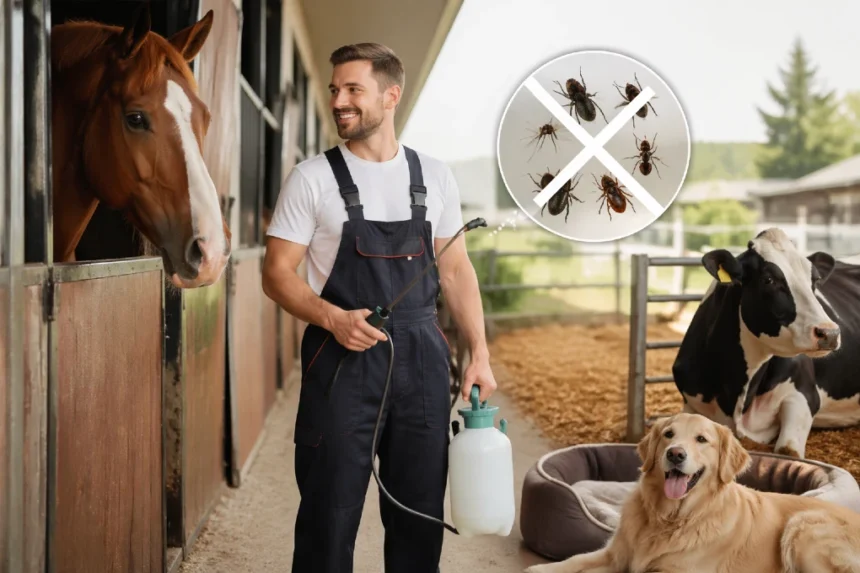
If you manage a stable, run a small farm, or simply want cleaner animal areas around your property, insect control quickly becomes more than a convenience. It becomes part of daily hygiene, animal comfort, and overall biosecurity. Dogacron is one of those products people come across when they are looking for a concentrated insecticide that can be used in livestock and animal environments rather than as a direct treatment for the animal itself. Product listings and manufacturer information describe it as an insecticide-acaricide concentrate for livestock settings, stables, farms, storage buildings, kennels, and other spaces where domestic or production animals are present.
- What Dogacron Is and What It Is Designed For
- Why Insect Problems Build Up in Stables, Farms, and Pet Spaces
- Dogacron Insecticide Uses in Stables
- Dogacron on Farms and Livestock Buildings
- Can Dogacron Be Used in Pet Spaces?
- What Pests Dogacron Is Commonly Associated With
- How to Use Dogacron More Effectively
- Safety Considerations Before Using Dogacron
- Dogacron Versus a General Pest Spray
- Frequently Asked Questions About Dogacron
- Conclusion
That distinction matters. In many real-world situations, the problem is not only the insects on the animal. The bigger issue is the environment around the animal. Flies breed in manure, wet bedding, feed waste, and damp organic matter. Crawling pests can hide in cracks, walls, corners, equipment edges, and poorly cleaned storage zones. Extension and veterinary sources consistently note that effective insect control in livestock facilities depends on sanitation first, with insecticides used as part of a broader program rather than as a standalone fix.
What Dogacron Is and What It Is Designed For
Dogacron is marketed as a concentrated emulsion insecticide-acaricide intended for zoosanitary or animal-environment use. Manufacturer and retailer descriptions say it is formulated for the control of both flying and crawling insects in livestock environments such as stables, farms, warehouses, poultry settings, and buildings where domestic animals are present. These sources also describe it as a water-mix concentrate with a shock or knockdown effect and residual persistence.
A manufacturer page identifies the active ingredients as cypermethrin 3%, acetamiprid 2.9%, azamethiphos 0.1%, and piperonyl butoxide 3%. That combination helps explain why the product is positioned as both fast-acting and longer-lasting in treated environments. Cypermethrin is a synthetic pyrethroid commonly used for quick knockdown, while piperonyl butoxide is often added as a synergist to improve insecticidal performance. Product pages for Dogacron specifically emphasize low-dose efficacy, persistence, and broad usefulness in livestock facilities.
In practical terms, Dogacron appears to be meant for premises treatment, not casual use on every surface and certainly not improvised use directly on pets unless the official label in your country explicitly allows that. That is an important safety point because authorities such as the EPA and NPIC consistently advise users to follow pesticide label directions exactly, especially around pets and animal spaces.
Why Insect Problems Build Up in Stables, Farms, and Pet Spaces
The reason products like Dogacron are in demand is simple. Animal environments create ideal conditions for pests.
In stables, flies are attracted to manure, damp bedding, and feed residues. On farms, pest pressure increases around livestock housing, feed bins, manure storage, and wet organic material. In kennel or pet-adjacent spaces, fleas, flies, and other insects may build up if waste, moisture, and resting harborage areas are not controlled. Purdue Extension notes that flies breed rapidly in wet decaying matter, and in favorable conditions a generation can develop in as little as about 7 to 10 days. Their dairy and livestock materials also stress that poor sanitation will undermine insecticide performance.
Veterinary sources also remind us that some flies are more than a nuisance. Stable flies are blood-feeders and can stress animals through painful bites, while face flies can contribute to irritation and disease spread around cattle. That is why environmental control around animals is not just about comfort. It is tied to welfare and productivity.
Dogacron Insecticide Uses in Stables
Stables are one of the most obvious places where Dogacron fits the search intent behind this topic. Product descriptions specifically mention stables and similar livestock buildings as target environments.
In a stable setting, Dogacron is best understood as a treatment for the structure and the environment. That usually means areas where pests rest, enter, or reproduce, subject to the official label directions. Common problem zones in equine spaces include wall edges, door frames, cracks, feed storage corners, manure-adjacent surfaces, and shaded resting points where flies settle. Environmental insecticide treatment can help reduce adult insect pressure, especially when paired with manure removal, dry bedding management, and better airflow. Extension guidance on livestock pest control repeatedly supports this combined approach.
A practical stable use case would be a facility struggling with recurring fly pressure during warm months. The owner cleans stalls daily but still sees insects resting in shaded corners and entering from nearby waste areas. In that scenario, a product like Dogacron may be used as part of a rotational pest control plan for the premises, while the real long-term win comes from removing breeding material and reducing moisture. That is exactly the kind of integrated thinking extension sources recommend.
Dogacron on Farms and Livestock Buildings
The strongest documented positioning for Dogacron is in farms and livestock facilities. Multiple product pages describe it for use in farms, barns, poultry-related spaces, pig housing, zoos, warehouses, and buildings where production animals are present.
This makes sense because farm pest management often involves two separate goals at once. The first is reducing active adult insects that disturb animals and workers. The second is lowering the overall pest population over time. A concentrated insecticide can help with the first part by knocking down adults in treated spaces. But long-term control still depends on drainage, waste handling, manure management, feed cleanup, and routine inspection of pest hot spots. Ohio State and Purdue materials both stress that sanitation is the most important part of a successful fly management program in and around livestock facilities.
For farm operators, the biggest value of a premises product like Dogacron is often its flexibility. It can be relevant in cattle housing, poultry areas, storage buildings, and general farm structures where insects rest or move through. Even so, the best farm results come when treatments are timed around insect pressure and applied to the right locations rather than sprayed casually everywhere. EPA-aligned pest management principles emphasize targeted action based on pest biology and site conditions, not random overuse.
Can Dogacron Be Used in Pet Spaces?
This is where readers need a clear answer. Dogacron is described in product listings as suitable for environments where domestic animals are present, including kennels and certain animal buildings. However, that does not automatically mean it should be applied directly to pets. The safer and more responsible interpretation is that it is an environmental treatment for pet-adjacent areas only when the product label authorizes that use.
That distinction matters because pesticide misuse around pets can cause irritation, poisoning, or residue problems. NPIC advises pet owners to follow label directions carefully and never exceed the stated dosage or use pattern. EPA guidance on flea and tick products makes the same point: pesticides sold for pet use are considered safe when used according to label directions and precautions.
So if you are thinking about Dogacron for a kennel, pet outbuilding, or animal shelter-type environment, the sensible use case is environmental pest control in the structure itself. Keep pets away during mixing or application if the label requires it, allow for proper drying or re-entry intervals, and never assume that an environmental insecticide is interchangeable with a pet body treatment.
What Pests Dogacron Is Commonly Associated With
Retailer and manufacturer descriptions connect Dogacron with flying insects such as flies, mosquitoes, and wasps, along with crawling pests such as fleas, lice, and cockroach-like infestations in livestock environments. Some pages also describe it as acaricidal, which suggests usefulness in environments where mites or similar arthropod pressure is part of the wider hygiene issue.
That broad positioning is useful in mixed animal settings because insect problems are rarely limited to one species. A stable can have flies in the warm season, crawling pests in storage zones, and nuisance insects near feed and moisture points all at the same time. This is why many managers prefer concentrates with both quick action and residual performance, provided they are using them within label limits. Product descriptions for Dogacron repeatedly highlight both a fast shock effect and longer persistence.
How to Use Dogacron More Effectively
The best results with Dogacron do not come from simply spraying more product. They come from using it at the right time, in the right place, alongside cleaner facility management.
Here is what that looks like in practice:
- Remove manure, soiled bedding, and feed waste regularly.
- Reduce standing moisture and improve drainage.
- Target pest resting and harboring sites rather than broad, unnecessary spraying.
- Rotate or vary control strategies where resistance is a concern.
- Monitor whether pests are actually decreasing after treatment.
These are not just common-sense habits. They are supported by extension, EPA, and resistance-management sources. EPA’s IPM principles emphasize combining knowledge of pest life cycles with practical control methods to reduce hazards and improve long-term results. Resistance-management guidance also warns against relying on one chemical strategy indefinitely.
There is another reason this matters. Purdue guidance notes that insecticides alone will not solve a fly problem under poor sanitary conditions. That is probably the single most important real-world insight for anyone considering Dogacron. If the breeding source remains, the apparent success of treatment can be short-lived.
Safety Considerations Before Using Dogacron
Whenever a product is used in or around animal environments, safety has to come first. That includes the safety of livestock, pets, handlers, children, feed, and water sources.
The first rule is simple: read and follow the label exactly. Educational and regulatory sources repeatedly stress that label directions are not casual suggestions. They are the core instructions for lawful and safe use. Storage, disposal, re-entry, surface use, dilution, and site limitations all come from the product label.
The second rule is proper storage and handling. EPA and ATSDR guidance recommends keeping pesticides in original containers, out of reach of children and pets, and disposing of them properly rather than pouring leftovers into drains or the ground.
The third rule is site awareness. In many animal buildings, there are feed troughs, water lines, tack, bedding, grooming tools, and porous surfaces that can all be affected by careless spraying. That is why a premises insecticide should be used with deliberate application technique, good ventilation, and attention to label restrictions on occupied areas. Some registered insecticide labels for livestock and kennel environments allow only limited crack-and-crevice treatment in occupied areas, which shows how important site-specific directions can be.
Dogacron Versus a General Pest Spray
One reason the keyword Dogacron attracts search traffic is that readers are often trying to decide whether they need a standard household bug spray or something more specialized.
A general household insecticide may be fine for indoor domestic pest issues, but animal spaces present different challenges. You may be dealing with manure-associated fly pressure, livestock-adjacent moisture, repeated reinfestation from outside, and surfaces used by animals every day. Dogacron is positioned specifically for these tougher environmental conditions in zoosanitary and livestock contexts, which is why it may be more relevant than a generic home product for barns, stables, and similar structures.
That said, specialized does not mean self-sufficient. The best product in the wrong system will still disappoint. If waste is not being managed, if drainage is poor, or if harborage sites are being ignored, the pest cycle simply restarts. That is why professional and academic sources keep returning to the same message: sanitation and monitoring are essential.
Frequently Asked Questions About Dogacron
Is Dogacron meant for direct use on animals?
Available product descriptions position Dogacron primarily as an insecticide-acaricide for animal environments, not as a universal direct-on-animal treatment. Always rely on the official product label for your market before using it near or on any animal.
Where is Dogacron most commonly used?
The most commonly described sites are stables, farms, livestock buildings, warehouses, kennels, poultry-related settings, and other structures where domestic or production animals are present.
What makes Dogacron different?
Manufacturer and retailer sources describe Dogacron as combining fast knockdown with residual persistence, supported by a formula that includes cypermethrin, acetamiprid, azamethiphos, and piperonyl butoxide.
Is one treatment enough?
Usually not. In livestock and animal spaces, lasting insect control depends on repeated sanitation, moisture control, inspection, and pest management timing, with insecticides used as one part of the program.
Conclusion
Dogacron stands out as a premises-focused insecticide for people dealing with pest pressure in stables, farms, livestock housing, and some pet-adjacent structures. Based on available product information, its main appeal is the combination of quick action, residual performance, and suitability for complex animal environments where flying and crawling insects can easily multiply.
Still, the smartest way to use Dogacron is not to treat it like a magic fix. The strongest results come when you pair the product with cleaner bedding practices, manure control, dry surfaces, regular inspections, and a broader integrated pest management mindset. That approach is the one most consistently supported by extension, veterinary, and regulatory sources, and it is also the approach most likely to keep animal spaces cleaner over time.
If your goal is a more comfortable stable, a cleaner farm building, or a better-managed pet space, Dogacron can make sense as part of that routine. Just make sure the application matches the official label, the space is managed properly, and the product is being used as an environmental control tool rather than as a shortcut around basic hygiene and prevention.