

If you have ever turned the key (or pressed the start button) and heard nothing but a weak click, you already know how fast an electrical problem can ruin your day. The tricky part is that car electrical issues rarely announce themselves clearly. A dim headlight might be a tired battery, a loose ground, a failing alternator, or even a software controlled module that never goes to sleep.
- What an Auto Electric Shop Actually Diagnoses (And Why It Matters)
- Common Signs of Car Electrical Problems
- Step 1: Confirm the Complaint Like a Technician
- Step 2: Start With Battery Health (Because It Causes So Many Problems)
- Step 3: Check the Charging System the Shop Way (Not the Guess Way)
- Step 4: Diagnose the Starting Circuit (Starter, Relay, and Control Side)
- Step 5: Hunt Parasitic Battery Drain (Dead Overnight Battery)
- Step 6: Wiring, Grounds, and “Invisible” Resistance Problems
- Step 7: Fuses, Relays, and Power Distribution Checks
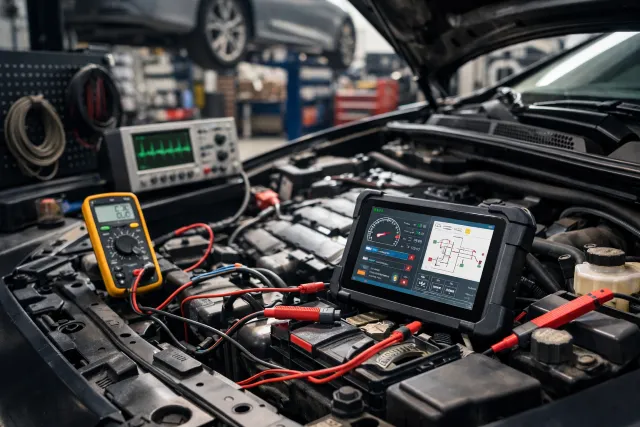
- Step 8: Scan Tools and Module Diagnostics (The Modern Reality)
- EVs and Hybrids: Extra Safety Notes
- Real World Diagnostic Examples
- FAQs About Auto Electric Shop Diagnostics
- Conclusion: What “Good Electrical Diagnosis” Really Looks Like
That is why a good Auto Electric Shop does not “guess and replace.” It follows a repeatable process: confirm the symptom, check the basics, test the charging and starting systems, and only then chase deeper wiring or module faults. In this guide, you will learn that same shop style workflow so you can understand what is happening, speak confidently with a technician, and avoid wasting money on the wrong part.
Car electrical problems are also more common than many people realize. AAA has reported that millions of roadside calls are tied to preventable issues such as battery failure, flat tires, and lockouts, with battery related trouble consistently near the top.
What an Auto Electric Shop Actually Diagnoses (And Why It Matters)
People often say “my car has an electrical issue” when they really mean one of three systems:
- Starting system: battery, cables, starter motor, starter relay/solenoid, ignition switch, related wiring.
- Charging system: alternator, voltage regulator (often built into the alternator), belt drive, battery connections, main grounds, fusible links.
- Power distribution and control: fuses, relays, body control module (BCM), engine control module (ECM), sensors, network wiring (CAN bus), and software logic.
A modern vehicle is not just wiring and bulbs. It is a rolling network of computers and modules. Many cars can have dozens of electronic control units, and the industry has discussed vehicles having up to around 100 ECUs in some designs. That complexity is a big reason why the same symptom can come from multiple causes.
Common Signs of Car Electrical Problems
Electrical faults tend to show up in patterns. Here are the signals shops listen for:
- Slow crank or clicking when starting
- Intermittent no start that “fixes itself” later
- Battery light on the dash or charging warnings
- Lights dimming or flickering, especially at idle
- Random warning lights across multiple systems
- Accessories acting weird: radio resets, power windows slow, dashboard goes blank
- Burning smell near fuse box or battery area (treat this as urgent)
- Blown fuses repeatedly
- Battery going dead overnight (parasitic drain)
Quick symptom to cause table
| Symptom | Most likely causes | First practical test |
|---|---|---|
| Single click, no crank | Weak battery, bad connection, starter relay/solenoid | Measure battery voltage + check cable tightness |
| Rapid clicking | Battery too weak to hold load | Load test battery |
| Starts with a jump, dies later | Alternator/charging failure, loose belt | Charging voltage test at idle |
| Dimming lights at idle | Alternator weak, bad ground, high load | Voltage drop test grounds + alternator output |
| Dead battery overnight | Parasitic draw, module staying awake | Parasitic draw test (ammeter) |
| One feature fails (only windows, only headlights) | Fuse, relay, switch, local wiring | Fuse/relay swap + verify power and ground |
This table does not replace proper testing. It just shows why a systematic approach matters.
Step 1: Confirm the Complaint Like a Technician
A good diagnostic starts with a clear, repeatable symptom. An Auto Electric Shop will usually ask questions like:
- When did it start, and was anything changed recently (battery replaced, stereo installed, accident, water intrusion)?
- Does it happen only when cold, only after driving, or randomly?
- Does it happen with extra electrical load (AC on, headlights on, defogger on)?
- Do warning lights appear with it?
Shops also try to reproduce the issue. An “intermittent” fault is where most money gets wasted, because people replace parts without catching the failure in the act. The key is evidence: measurements, not guesses.
Step 2: Start With Battery Health (Because It Causes So Many Problems)
Even if you suspect the alternator, the battery is still the first checkpoint. A weak battery can imitate charging problems, starter problems, and even create false sensor codes because modules dislike low voltage.
AAA has highlighted how battery trouble is a major contributor to roadside breakdowns, which is why shops treat battery testing as step one, not an afterthought.
Battery tests an Auto Electric Shop uses
- Open circuit voltage (resting voltage)
After the car has been off for a while, battery voltage gives a rough snapshot. It is not a perfect health test, but it is a useful clue. - Load test (the real test)
A healthy battery must hold voltage under load. Many shops use a dedicated load tester or conductance tester. If voltage collapses under load, the battery is not doing its job. - Cable and terminal inspection
Corrosion and loose connections can mimic a dead battery. That chalky white buildup is not just cosmetic, it adds resistance.
A simple scenario
Your car starts fine for weeks, then one morning it barely cranks. You jump start it and it runs. That does not automatically mean the alternator is bad. A battery can accept enough surface charge from a jump to run the car, yet still fail under the heavy load of starting. That is why shops verify battery performance under load before blaming the alternator.
Step 3: Check the Charging System the Shop Way (Not the Guess Way)
Once the engine is running, the alternator is supposed to power the electrical system and recharge the battery. If the alternator is weak, the battery ends up doing the alternator’s job until it dies.
Many technician style guides describe charging system diagnosis as a chain: verify belt drive, verify connections, measure output voltage, then test under load and check voltage drop across the wiring. Heavy duty diagnostic manuals emphasize that the starting and charging systems are connected through batteries, starter, alternator, and interconnecting wiring, and they outline using accurate voltage measurements and current measurement tools.
What shops measure
- Charging voltage at idle and at slightly higher RPM
- Charging voltage under load (headlights, blower motor, rear defogger)
- Voltage ripple (to check alternator diode issues)
- Voltage drop tests on the positive cable and ground path
A voltage drop test is one of the most underrated skills in car electrical work. Instead of only checking “does power exist,” it checks “how much power is lost before it reaches the component.”
Some diagnostic worksheets and manuals specify acceptable voltage drop limits under load for cables, because resistance is the silent killer in electrical systems.
Step 4: Diagnose the Starting Circuit (Starter, Relay, and Control Side)
If the battery tests good, and the charging system is not obviously failing, the next target is the starting circuit.
The starter system has two sides
- High current side: battery cable to starter, starter motor, engine ground, battery ground.
- Control side: ignition switch or push button signal, starter relay, neutral safety switch, clutch switch, immobilizer logic, and module permissions.
Here is why that split matters: you can have a healthy starter motor that never receives the “permission” signal to crank due to a switch, relay, or security system issue.
Typical no crank workflow in an Auto Electric Shop
- Verify battery load performance.
- Confirm the starter is receiving power on the main feed.
- Check whether the starter solenoid gets a signal when you try to start.
- If signal is missing, trace back through relay, fuses, switch, and module control logic.
- If signal is present but no crank, test the starter motor and ground path.
That workflow saves money because it prevents “starter roulette” where a starter is replaced when the real issue is a relay, ground strap, or a failing ignition switch.
Step 5: Hunt Parasitic Battery Drain (Dead Overnight Battery)
A car that dies overnight is one of the most frustrating electrical problems because it feels random, and people start blaming the battery over and over.
Parasitic drain means something is drawing power while the vehicle is off. The culprit can be:
- Glove box or trunk light staying on
- Aftermarket stereo or alarm wiring
- A stuck relay
- A control module that never enters sleep mode
- Water intrusion causing corrosion and leakage current
How shops test it
- Turn the car off and let modules go to sleep (some cars take time).
- Measure current draw with an ammeter in series.
- Pull fuses one by one to find which circuit drops the draw.
- Once the circuit is identified, isolate components on that circuit.
This approach is slow, but it is reliable. It is also where a truly skilled Auto Electric Shop earns its reputation.
Step 6: Wiring, Grounds, and “Invisible” Resistance Problems
When electrical issues are intermittent, wiring and grounds are often involved. A wire can look fine and still fail under vibration, heat, or moisture.
The three usual wiring villains
- Ground faults
Bad grounds can cause multiple unrelated systems to malfunction because modules share ground points. - Connector corrosion
A little corrosion creates resistance. Resistance creates heat. Heat worsens the connection. That cycle creates intermittent failures. - Chafed wiring
Wires rubbing against metal can short to ground and blow fuses, or short to power and cause unpredictable behavior.
An Auto Electric Shop typically does “wiggle testing” on suspect harness sections while monitoring voltage or scan data. The idea is simple: recreate the fault while measuring it.
Step 7: Fuses, Relays, and Power Distribution Checks
Fuses are obvious, but relays are often misunderstood. A relay can click and still fail to pass current properly. Also, a fuse can look intact and still be cracked or have poor contact at the fuse box.
Relay testing in real shops
- Swap with an identical known good relay (when safe and appropriate)
- Verify power feed to relay
- Verify control signal triggers the coil
- Verify output side delivers power under load
Power distribution problems become more common as vehicles add more electrical loads and more modules.
Step 8: Scan Tools and Module Diagnostics (The Modern Reality)
Some electrical problems are not “wiring problems,” they are logic problems. Today’s vehicles decide when to power systems on and off through software. A module might disable charging under certain failure conditions, or keep a circuit awake because it thinks the car is still “active.”
That is why skilled shops combine electrical testing with scan tool diagnosis:
- Reading fault codes and freeze frame data
- Checking live data (battery voltage seen by modules, alternator command, load signals)
- Verifying communication networks (CAN bus issues can cause chaos)
- Checking module sleep status in parasitic draw cases
This is also why random warning lights across the dash can point to a weak battery or poor grounds. Modules react badly to low voltage, and they can throw misleading codes when supply voltage is unstable.
EVs and Hybrids: Extra Safety Notes
If you drive a hybrid or EV, electrical diagnosis includes a high voltage system that can seriously injure an untrained person. Even in EVs, there is still a traditional 12V system that can fail and create strange symptoms.
NHTSA has highlighted ongoing work around EV battery safety and research initiatives, reflecting how seriously high voltage safety is treated at the industry and regulator level.
A professional Auto Electric Shop that services hybrids/EVs follows high voltage safety procedures, uses insulated tools, and adheres to manufacturer guidelines. This is not the place for improvisation.
Real World Diagnostic Examples
Example 1: “I replaced the battery, but it still dies”
A shop tests parasitic draw and finds it is too high after the car should be asleep. Pulling fuses shows the drain is on an infotainment circuit. The root cause turns out to be an aftermarket head unit wired to constant power instead of switched power. Fixing the wiring solves it permanently. The battery was not the real problem.
Example 2: “It cranks slow only after driving”
Battery tests okay at rest. Starter tests okay cold. The shop performs voltage drop tests when the engine is hot and finds excessive resistance in the positive cable near the starter where heat has damaged internal strands. Replacing the cable fixes the hot start slow crank.
Example 3: “My headlights flicker and my dash lights pulse”
Charging voltage looks borderline. Under load, voltage dips and ripple increases. The alternator has a failing diode. The shop confirms with ripple testing and output current testing, then replaces the alternator and checks belt condition. The flicker disappears.
FAQs About Auto Electric Shop Diagnostics
What does an Auto Electric Shop check first?
Usually the battery and its connections first, then the charging system, then the specific circuit related to your symptom. This order prevents misdiagnosis because weak voltage can cause multiple false symptoms.
Can a bad alternator look like a bad battery?
Yes. If an alternator is not charging, the car runs off the battery until the battery drains. That can make it look like “the battery keeps dying” even if the battery is fine.
Why do electrical problems feel random?
Heat, vibration, moisture, and intermittent connector contact can make faults come and go. Software controlled modules can also behave differently depending on vehicle state, temperature, and battery voltage.
Is it safe to diagnose electrical problems at home?
Basic checks like visual inspection and confirming battery terminals are tight can be safe. But deeper testing, especially on hybrids/EVs or when you suspect wiring damage, should be handled with proper tools and training due to risk of shock or fire.
Conclusion: What “Good Electrical Diagnosis” Really Looks Like
A reliable electrical diagnosis is not magic. It is disciplined testing. A professional Auto Electric Shop starts with battery health, verifies charging performance, tests voltage drops in cables and grounds, and then moves into circuits, relays, wiring, and module logic. That sequence prevents expensive mistakes and gets to the real cause faster.
As vehicles become more software driven and module heavy, understanding the basics of the starting and charging system is still the foundation. Even with dozens of computers onboard, the car still depends on clean power, solid grounds, and stable voltage. And when you hear a technician explain your issue using measurements and test results instead of guesses, you are watching proper electrical work in action.
In the last step of any repair conversation, it helps to speak the same language. If you can describe symptoms clearly and understand the vehicle’s vehicle electrical system at a basic level, you will make better decisions and avoid repeat failures.