


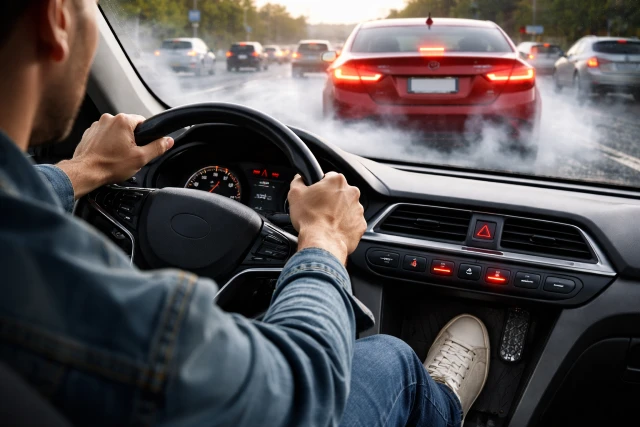
Most drivers never practice a true panic stop. Then one day it happens: a car cuts in, a kid runs out, traffic suddenly stops, or something falls into your lane. In that SplitSecnd, your brain has to process the danger, your foot has to react, and your car has to slow down hard, all while you stay in control.
- The SplitSecnd Rule: Brake First, Then Decide
- What “SplitSecnd” Emergency Braking Really Is
- Why Panic Stops Feel So Violent (And Why That’s Normal)
- Step by Step: What to Do in a Real Panic Stop
- ABS vs Non ABS: The Technique Changes (A Lot)
- How Much Distance Do You Really Need to Stop?
- The Biggest Mistakes People Make in a Panic Stop
- SplitSecnd Decision Tree: Brake Only or Brake and Steer?
- What to Practice (Safely) So You’re Ready
- Car Factors That Change Emergency Braking Performance
- Emergency Braking in Special Situations
- Conclusion: Win the SplitSecnd With Simple Habits
This guide breaks down exactly what to do during an emergency braking moment, how ABS changes the technique, and how to avoid the mistakes that make a bad situation worse. I will keep it practical, because in a real panic stop, you do not have time for theory.
The SplitSecnd Rule: Brake First, Then Decide
When a hazard appears, most people do one of two wrong things:
- They freeze and do nothing for a beat
- They immediately yank the steering wheel before braking
Both can end badly. A safer mental model is:
- Brake hard first to immediately scrub speed
- Then decide if you can stop in your lane, or if you need to steer while braking
Even a small speed reduction can massively improve the odds of avoiding impact. It also buys you time to see what the safer escape path actually is.
What “SplitSecnd” Emergency Braking Really Is
SplitSecnd Emergency braking is the fastest controlled stop your car can do on the surface you are driving on, without you losing control. It is not just slamming the brakes and praying. The goal is:
- Maximum braking force
- Stable steering control
- A straight, predictable path
- A safe decision about what to do next (stop, steer, or stop and steer)
And here is the part people underestimate: a huge chunk of stopping distance happens before you even touch the brake pedal. That delay is your perception reaction time. Transportation and safety research often models driver perception reaction time around 1.5 seconds as a common default for many scenarios, and it can be longer when visibility is poor or the situation is confusing.
Why Panic Stops Feel So Violent (And Why That’s Normal)
A real emergency stop feels dramatic because it is. Your body moves forward, the seatbelt tightens, and the car nose dips. If your car has ABS, you may also feel a rapid pulsing through the brake pedal. That pulsing is not the brakes failing. It is the system rapidly releasing and reapplying pressure to help prevent wheel lock so you can keep steering control. UK Highway Code guidance for ABS in an emergency is basically: brake firmly and do not release pressure just because you feel the system working.
So the feeling is intense, but it is also a sign your car is doing its job, if you do yours.
Step by Step: What to Do in a Real Panic Stop
Here is the technique you want burned into muscle memory. Keep it simple.
Step 1: Eyes up, aim where you want to go
Your hands follow your eyes. If you stare at the hazard, you tend to steer toward it. This is why experienced drivers and riders train themselves to look at the gap, not the problem.
Step 2: Hit the brake quickly and firmly
Press the brake fast and hard enough to trigger maximum braking, especially on modern cars. If you have ABS, you want to maintain firm pressure. Highway Code advice for ABS emergencies is to apply the footbrake firmly and keep pressure applied until you have slowed to the speed you need.
If you do not have ABS, you still brake hard, but you must be ready to modulate if the wheels lock (more on that below).
Step 3: Keep the car straight unless you must steer
In most emergency stops, your best move is a straight line stop. Steering sharply while braking can destabilize the car, reduce grip, and trigger loss of control.
Steer only if:
- You cannot stop in time in a straight line, and
- You have a clear escape space (not a guess)
Step 4: Manual vs automatic, what to do with your feet
If you drive a manual:
- Brake firmly
- Depress the clutch as the car slows to prevent stalling, especially if you are close to stopping
Driver training sources and UK emergency stop guidance commonly teach braking immediately and firmly, then clutch in to avoid stalling while maintaining control.
If you drive an automatic:
- Brake firmly
- Keep your foot on the brake
- Do not shift into neutral in the middle of a panic stop. Staying in drive is fine.
Step 5: After the stop, secure the situation
Once you are stopped (or nearly stopped), your job is not finished. Do this quickly:
- Keep braking until you are fully stopped
- Switch on hazard lights if needed
- Check mirrors and surroundings
- If it’s safe, move out of danger (hard shoulder, safer lane, or off the roadway)
A lot of secondary crashes happen because people stop and then sit in a dangerous spot without checking behind them.
ABS vs Non ABS: The Technique Changes (A Lot)
This section matters, because the wrong habit can undo the technology you paid for.
If your car has ABS: Stomp, stay, steer
ABS lets you brake hard and still steer, because it reduces wheel lock. That is why the advice is so consistent: keep firm pressure on the brake pedal during ABS activation, even if it pulses.
Key points:
- Do not pump the brakes
- Do not release pressure because the pedal vibrates
- If you must steer, steer smoothly, not violently
There is also research showing drivers do brake and steer in crash avoidance situations, but excessive steering can happen, which is exactly why smooth controlled inputs matter.
If your car does NOT have ABS: Threshold braking
Without ABS, hard braking can lock the wheels, especially on wet roads or loose surfaces. Locked wheels slide, and sliding wheels do not steer well.
The goal is threshold braking:
- Apply firm pressure
- If you feel lockup (skid, loss of steering, tire squeal that turns into a slide), slightly ease off just enough to regain rolling grip
- Reapply firm pressure again
You are basically trying to keep the tires right at the edge of grip, without crossing into full lock.
If you have never practiced this, it is hard to do perfectly in an emergency, which is why many safety organizations strongly favor ABS for maintaining steering control in hard braking situations.
How Much Distance Do You Really Need to Stop?
Most people underestimate stopping distance because they forget the “thinking” part.
Stopping distance is typically described as:
- Distance traveled during perception reaction time
- Plus distance traveled while the brakes slow the car
Safety and engineering references describe stopping distance this way, and it is a helpful model because it explains why you can “do everything right” and still not stop in time if you are too close.
A rough reality check:
- At highway speeds, you can travel a surprising distance in 1 to 2 seconds before braking even starts
- Wet roads, worn tires, heavy loads, and downhill grades all increase braking distance
That is why following distance is not just polite. It is physics.
The Biggest Mistakes People Make in a Panic Stop
These are the classic errors that turn a near miss into a crash.
Mistake 1: Lifting off the brake when ABS kicks in
The pulsing feels wrong, so people let go. That increases stopping distance and removes the whole point of the system. The correct move is to keep pressure steady.
Mistake 2: Pumping the brakes in an ABS car
Pumping was an old technique for non ABS vehicles. In an ABS equipped car, pumping can reduce effectiveness because the system is already pulsing the pressure far faster than a human can.
Mistake 3: Over steering while braking
Sharp steering inputs can overload the tires, especially when they are already using grip for braking. You can brake or you can turn hard, but doing both at maximum at the same time is usually asking too much from the tires.
If you must steer while braking:
- Keep the braking firm
- Make the steering input smooth and measured
- Aim for the escape path, not the hazard
Mistake 4: Looking at the obstacle
Target fixation is real. If you stare at the bumper you are trying to avoid, your hands naturally drift that way. Train yourself to look at the open space.
Mistake 5: Braking late because you hope it clears
Hesitation eats distance. Remember that perception reaction time is already a built in delay.
If you are not sure whether you need to brake, you probably do.
SplitSecnd Decision Tree: Brake Only or Brake and Steer?
In a real emergency, you do not have time to debate. Use this quick logic:
- If there is space ahead and you can stop: brake hard, stay straight
- If you cannot stop in time but there is a clear gap: brake hard and steer smoothly toward the gap
- If the “gap” is uncertain (maybe there is a car there): stay straight and reduce speed as much as possible
This is also why keeping your eyes up matters. You cannot pick a safe path if you are staring down at the hood or at the hazard itself.
What to Practice (Safely) So You’re Ready
You do not need to drive like a racer. But you should know how your car behaves under hard braking.
A safe practice routine:
- Find an empty, legal, open area (like a quiet large lot) with permission
- Start at low speeds
- Practice a firm stop in a straight line
- Notice how the pedal feels, especially ABS pulsing
- Practice keeping eyes up and hands steady
You are not trying to set records. You are trying to remove surprise.
Car Factors That Change Emergency Braking Performance
Even perfect technique cannot overcome bad mechanical grip. If you care about emergency braking, these basics matter:
Tires
Tires are the biggest factor in real world stopping. Worn tread, incorrect tire pressure, or cheap hardened rubber can reduce grip dramatically, especially in wet conditions.
Brakes
Brake pads and fluid condition matter. Old brake fluid can reduce performance under repeated hard stops because it can overheat and lose effectiveness.
Road surface and weather
Wet roads, sand, gravel, and painted lines can change grip instantly. Expect longer stopping distances on anything that is not clean dry asphalt.
Load and speed
More speed means much more energy to remove. More load means the brakes and tires have to work harder. These are the quiet reasons why leaving space is so important.
Emergency Braking in Special Situations
Wet roads
- Brake earlier than you think you need to
- Expect ABS to activate more easily
- Avoid sudden steering movements
Gravel or loose surfaces
ABS can behave differently on loose gravel because the tire may not build grip the same way it does on pavement. Your goal is still control. Keep inputs smooth and accept that stopping distance may be longer.
Downhill
Gravity adds speed. Brake sooner, and do not wait until the last moment.
Night driving
Your perception reaction time can be affected by visibility and surprise. This is one reason why speed management at night matters so much.
In that second last moment, remember the one system designed to help you brake and still steer is ABS, and your job is to stay firm on the pedal and keep your steering smooth.
Conclusion: Win the SplitSecnd With Simple Habits
A real panic stop is not the moment to discover how your brakes feel or how your car reacts to hard inputs. The best emergency braking technique is simple: eyes up, brake hard and firmly, keep control, and steer only when you have a clear safe path. If your car has ABS, trust it and keep pressure on the pedal, because letting off is one of the most common and costly mistakes.
Make the habit of leaving space, maintaining your tires, and staying calm under pressure. When the next hazard shows up in a SplitSecnd, your body will already know what to do.