


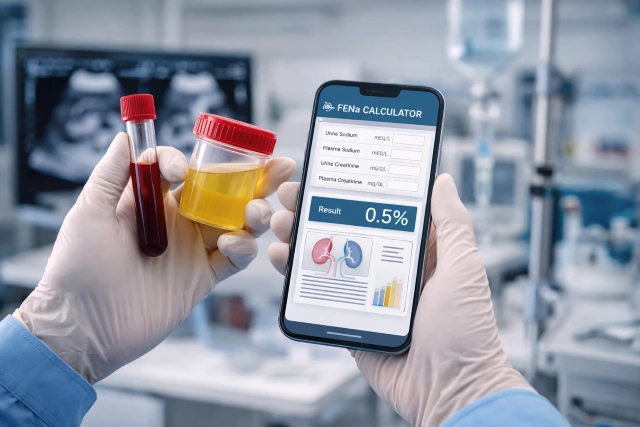
The fena calculator is a widely used clinical tool that helps medical professionals evaluate kidney function by analyzing how the body handles sodium. In patients with acute kidney issues, understanding sodium excretion patterns plays a crucial role in diagnosis and treatment decisions. This calculation is especially valuable in differentiating types of acute kidney injury based on physiological response rather than symptoms alone.
- What Is a Fena Calculator?
- Understanding Fractional Excretion of Sodium
- Digital Tools and Medical Calculators
- Why the Fena Calculator Matters in Clinical Practice
- Fena Calculation Formula Explained
- How the Fena Calculator Works Step by Step
- Fena Value Interpretation in Clinical Context
- Interpreting Borderline and Intermediate Values
- Conditions Where Fena Calculator Is Commonly Used
- Limitations of the Fena Calculator
- Fena Calculator vs Other Renal Indices
- Case Example: Applying the Fena Calculator
- Role in Emergency and Critical Care
- Research and Evidence Supporting Fena Use
- Educational Importance for Medical Students
- Common Misconceptions About Fena
- How Fena Calculator Fits Into Broader Renal Assessment
- Practical Use in Hospital Settings
- Frequently Asked Questions
- Global Use and Clinical Guidelines
- Ethical and Clinical Responsibility
- Conclusion
This article provides a complete and easy-to-understand explanation of the fena calculator, including how the fractional excretion of sodium calculator works, the fena calculation formula, and how fena value interpretation is used in real clinical scenarios. By breaking down both the science and practical application, readers gain clarity on why this calculation remains a cornerstone in nephrology and emergency medicine.
What Is a Fena Calculator?
A fena calculator is a medical calculation tool used to determine the fractional excretion of sodium (FENa). It measures the percentage of sodium filtered by the kidneys that is ultimately excreted in the urine.
Rather than focusing solely on sodium levels, the calculation compares sodium and creatinine values in both blood and urine. This approach provides insight into whether the kidneys are conserving or wasting sodium, which reflects underlying kidney physiology.
Understanding Fractional Excretion of Sodium
The concept behind fractional excretion is based on kidney filtration and reabsorption. Healthy kidneys filter sodium freely but reabsorb most of it to maintain fluid balance.
When kidney function is impaired, this balance changes. The fractional excretion of sodium calculator quantifies that change, helping clinicians understand whether reduced kidney output is due to decreased blood flow or intrinsic kidney damage.
Digital Tools and Medical Calculators
Modern healthcare increasingly relies on digital tools for accuracy and efficiency. Online calculators and clinical apps automate complex equations like FENa.
Medical calculation tools, diagnostic aids, and health-related digital utilities are often discussed within Noodlemag’s Gadgets category, which explores how technology supports healthcare and diagnostics.
Why the Fena Calculator Matters in Clinical Practice
The fena calculator is most commonly used in cases of acute kidney injury (AKI). AKI can arise from different causes, and treatment depends heavily on identifying the underlying mechanism.
By calculating sodium excretion efficiency, clinicians can differentiate between pre-renal causes (such as dehydration or reduced blood flow) and intrinsic renal causes (such as tubular damage). This distinction is critical for effective management.
Fena Calculation Formula Explained
The fena calculation formula compares sodium and creatinine concentrations in blood and urine. It is expressed as:
FENa (%) =
(Urine Sodium × Serum Creatinine) ÷ (Serum Sodium × Urine Creatinine) × 100
This formula adjusts sodium excretion relative to kidney filtration, providing a normalized value that reflects renal handling rather than raw concentrations.
How the Fena Calculator Works Step by Step
First, laboratory values are obtained for urine sodium, serum sodium, urine creatinine, and serum creatinine. These values are entered into the calculation.
The resulting percentage represents the fraction of filtered sodium excreted in urine. This percentage forms the basis for diagnostic interpretation rather than serving as a standalone diagnosis.
Fena Value Interpretation in Clinical Context
Fena value interpretation is straightforward but clinically powerful. Generally accepted ranges help guide diagnosis.
A value below 1 percent suggests that the kidneys are conserving sodium, often seen in pre-renal conditions. A value above 2 percent typically indicates intrinsic kidney damage, where sodium reabsorption is impaired.
Interpreting Borderline and Intermediate Values
Not all results fit neatly into textbook ranges. Values between 1 and 2 percent require clinical correlation.
In such cases, patient history, medication use, and additional laboratory tests are considered alongside the fena calculator result to reach an accurate conclusion.
Conditions Where Fena Calculator Is Commonly Used
The fena calculator is most frequently applied in acute kidney injury evaluation. It is particularly useful in hospitalized patients with reduced urine output.
It is also used in intensive care settings, emergency departments, and nephrology consultations where rapid differentiation of renal causes is essential.
Limitations of the Fena Calculator
Although valuable, the fena calculator is not universally applicable. Certain conditions can affect sodium handling independently of kidney damage.
For example, patients on diuretics may show elevated sodium excretion despite having pre-renal kidney injury. In such cases, alternative indices may be preferred.
Fena Calculator vs Other Renal Indices
Other tools, such as fractional excretion of urea, are sometimes used when sodium-based calculations are unreliable.
Despite these alternatives, the fractional excretion of sodium calculator remains one of the most commonly taught and applied tools due to its simplicity and physiological relevance.
Case Example: Applying the Fena Calculator
Consider a patient presenting with low urine output and elevated serum creatinine. Laboratory tests reveal low urine sodium and normal serum sodium.
Using the fena calculator, the result is 0.5 percent. This suggests pre-renal azotemia, often caused by dehydration or reduced renal perfusion. Treatment would focus on restoring blood volume rather than invasive renal interventions.
Role in Emergency and Critical Care
In emergency medicine, rapid decision-making is essential. The fena calculator provides actionable insight within minutes once laboratory data is available.
This speed supports early intervention and reduces the risk of progression to more severe kidney injury.
Research and Evidence Supporting Fena Use
Clinical studies published in nephrology journals have consistently shown that fractional sodium excretion correlates with renal tubular function.
According to research referenced by the National Kidney Foundation, FENa remains a validated parameter in the assessment of acute renal dysfunction when used appropriately.
Educational Importance for Medical Students
The fena calculator is a foundational concept taught in medical education. It reinforces understanding of renal physiology, filtration, and electrolyte balance.
Learning how to calculate and interpret FENa helps students bridge theoretical knowledge with clinical reasoning.
Common Misconceptions About Fena
One common misconception is that FENa alone can diagnose kidney disease. In reality, it is a supportive tool rather than a definitive test.
Another misunderstanding involves confusing sodium intake with sodium excretion. The calculator evaluates renal handling, not dietary sodium consumption.
How Fena Calculator Fits Into Broader Renal Assessment
Kidney evaluation typically involves multiple parameters, including urine output, imaging, blood chemistry, and clinical history.
The fena calculator complements these assessments by offering a focused view of tubular sodium handling, enhancing diagnostic confidence.
Practical Use in Hospital Settings
Hospitals frequently incorporate FENa into renal assessment protocols. Laboratory information systems often calculate it automatically when relevant values are available.
This integration reduces calculation errors and speeds up clinical workflows.
Frequently Asked Questions
What does a low FENa indicate?
It usually suggests pre-renal kidney injury where sodium is conserved.
Can FENa be used in chronic kidney disease?
It is primarily used for acute kidney injury assessment.
Is the fena calculator affected by medications?
Yes, diuretics can significantly alter results.
Global Use and Clinical Guidelines
International nephrology guidelines reference FENa as part of acute kidney injury evaluation frameworks.
Its continued inclusion in guidelines highlights its enduring relevance in modern medicine.
Ethical and Clinical Responsibility
Accurate interpretation of the fena calculator requires clinical judgment. Results must always be interpreted within the broader clinical picture.
Responsible use ensures that patients receive appropriate and timely care.
Conclusion
The fena calculator remains a simple yet powerful tool for understanding renal sodium handling and evaluating kidney function. Through its clear mathematical foundation, practical fena calculation formula, and clinically meaningful fena value interpretation, it supports accurate differentiation of acute kidney injury causes. When used alongside clinical assessment and laboratory data, the fractional excretion of sodium calculator enhances diagnostic precision and patient care. Backed by decades of clinical research and supported by authoritative organizations like the National Kidney Foundation, the fena calculator continues to be an essential component of modern renal evaluation.