


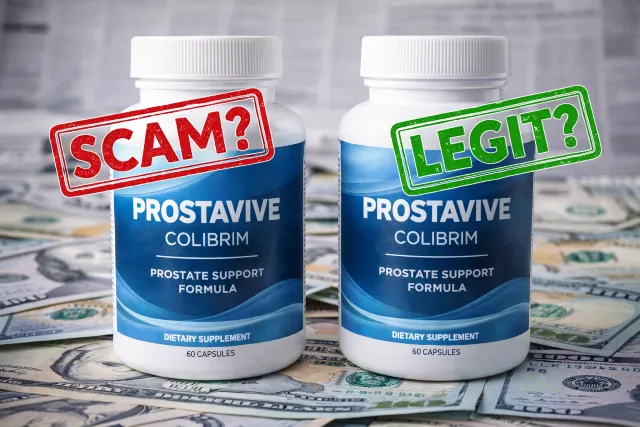
If you have been seeing Prostavive Colibrim pop up in ads, “review” blogs, or promo pages that look like news articles, you are not alone. The name has been circulating across the internet as a prostate support supplement, often paired with bold promises about urinary flow, nighttime bathroom trips, and “natural” fixes. The problem is that the online supplement world moves fast, and not every trending product has clear sourcing, clear evidence, or clear accountability. That is why people are asking the same question: is Prostavive Colibrim legit, or is it another internet scam in a fresh outfit?
- What is Prostavive Colibrim, based on what’s online
- A reality check on prostate symptom claims
- The biggest marketing red flags we noticed around Prostavive Colibrim
- Do the common supplement ingredients have strong evidence
- How scam-style supplement funnels usually work
- What reputable regulators say about misleading health product claims
- What we can and cannot conclude about Prostavive Colibrim
- A practical checklist people use to judge whether a supplement is legit
- Table: Scam-style signals vs legit-style signals
- What if someone is experiencing urinary symptoms
- FAQs
- Conclusion
In this report-style breakdown, we looked at how Prostavive Colibrim is being marketed, the kinds of claims typically attached to it, the red flags to watch for in supplement promotions, and what reputable health and regulatory sources say about supplement claims, reviews, and prostate symptom relief.
What is Prostavive Colibrim, based on what’s online
Across various pages and “review” posts, Prostavive Colibrim is described as a dietary supplement aimed at prostate health and urinary support, commonly framed around symptoms linked to benign prostatic hyperplasia (BPH) or lower urinary tract symptoms. Many of these pages repeat a similar storyline: inflammation, hormone balance, and improved urinary flow, often without showing clinical trial data for the finished product itself.
That does not automatically prove fraud, but it does explain why scam concerns exist. When a product’s identity feels scattered across lookalike pages, it becomes harder to answer basic consumer questions like: Who makes it, where is it manufactured, what is the exact formula, and who is responsible for quality control?
A reality check on prostate symptom claims
Many marketing pages position products like Prostavive Colibrim as solutions for common urinary symptoms: frequent urination, weak stream, waking up at night, discomfort, and “enlarged prostate” concerns. Those symptoms can be associated with BPH, but they can also overlap with infections, prostatitis, medication side effects, or other issues that require medical evaluation.
The American Urological Association (AUA) publishes evidence-based guideline resources on BPH and lower urinary tract symptoms, reflecting that this is a complex medical area with multiple validated treatment pathways, not just one supplement solution.
This matters because marketing tends to flatten nuance. Real health guidance does not.
The biggest marketing red flags we noticed around Prostavive Colibrim
Red flag 1: “FDA approved” language for a supplement
Some supplement pages use language that implies FDA approval or endorsement. But consumers often misunderstand what the FDA does and does not approve in the supplement space. FDA guidance also draws a line between structure/function claims (supporting normal body function) and disease claims (treating, curing, preventing disease).
When a page reads like a drug label while selling a supplement, it creates confusion at best and deception at worst.
Red flag 2: The “news article” layout that is really an ad
Many viral supplement funnels use advertorial formatting: headlines, “reports,” dramatic testimonials, countdown timers, and urgency tactics. The FDA explicitly warns consumers about health fraud scams: products that claim to prevent, treat, or cure conditions without being proven safe and effective for those uses.
Red flag 3: Lots of “review” content, but little transparent evidence
A common pattern is dozens of sites posting near-identical reviews, often with the same structure and claims. That is where the FTC’s guidance on health product advertising and substantiation becomes relevant.
Do the common supplement ingredients have strong evidence
Because many pages discussing Prostavive Colibrim reference “natural ingredients,” it helps to look at what the science says about popular prostate supplement ingredients in general.
Saw palmetto: popular, but evidence is mixed and often disappointing
Saw palmetto is one of the best-known prostate supplement ingredients. It is widely sold for urinary symptoms linked to BPH. But the National Center for Complementary and Integrative Health (NCCIH) summarizes that while some small studies suggested modest benefit, larger trials and a Cochrane review found saw palmetto was not more effective than placebo for urinary symptoms related to BPH.
Harvard’s health publishing has also noted skepticism around saw palmetto’s benefits for enlarged prostate symptoms, aligning with the broader evidence trend.
What that means in plain English: even the “famous” prostate supplement ingredient is not a guaranteed fix.
The bigger issue: ingredient evidence is not the same as product evidence
Even if an ingredient has some supportive studies, that does not automatically validate a finished supplement product, because:
- dosage may differ
- ingredient quality may differ
- combinations may not behave the same way
- the final product may not be tested in humans
This is why health claims require careful substantiation standards in advertising.
How scam-style supplement funnels usually work
This is where the “Colibrim” angle becomes important. The word appears in various storefront-like domains, and multiple “official” style pages circulate online.
Many supplement funnels follow a familiar playbook:
- An ad promises a “breakthrough”
- A long page tells a dramatic story
- Testimonials and review snippets build emotional trust
- Urgency triggers push quick purchases
- Checkout pages emphasize bundles and “limited stock”
None of these steps prove a product is fake. But they do explain why internet users feel uneasy. The funnel is designed for conversion first, clarity second.
What reputable regulators say about misleading health product claims
This is the part most review blogs skip, because it is less exciting than miracle stories, but it is the foundation for judging legitimacy.
FDA: watch out for health fraud scams
The FDA warns that health fraud scams refer to products that claim to prevent, treat, or cure diseases or health conditions without being proven safe and effective for those uses.
FTC: health product claims need real support
The FTC’s Health Products Compliance Guidance explains expectations for truthful, non-misleading claims supported by science.
The FTC also publishes consumer-focused warnings that supplements are not evaluated by FDA for safety and effectiveness, and that “natural” does not automatically mean safe, especially with medications or health conditions.
FTC and reviews: fake testimonials are a big deal now
If a product’s reputation is mainly built on reviews, it matters that the FTC’s rule addressing deceptive reviews and testimonials took effect October 21, 2024.
In other words, “lots of 5-star stories” is not the same as real credibility.
What we can and cannot conclude about Prostavive Colibrim
Here’s the cleanest way to say it, based on publicly visible patterns.
What we found
- Prostavive Colibrim is widely described online as a prostate and urinary support supplement.
- The term “Colibrim” appears across multiple storefront-style web properties and product pages, which can make the product identity feel fragmented.
- Much of the online “evidence” is marketing content or affiliate-style reviews, not clinical trial publications for the finished product.
What we cannot confirm from marketing pages alone
- Independent lab testing for purity and accurate labeling
- Clinical trial results for the specific branded product
- A single, consistent manufacturer record that is easy for consumers to verify
That gap is where the scam concerns come from. When verification is hard, uncertainty grows.
A practical checklist people use to judge whether a supplement is legit
This section is written as a reality-based “how people evaluate” checklist, not as hype.
Identity and accountability checks
- Is the manufacturer clearly named on the label and site
- Is there a real customer support channel
- Are refund terms clear and realistic
- Does the product have consistent branding across one primary domain
Claim quality checks
- Does it claim to “treat” or “cure” a disease (big red flag)
- Are the claims framed as structure/function support with appropriate disclaimers (common in supplements)
- Are citations to studies specific and traceable, or vague and unnamed
Review quality checks
- Are reviews spread across credible platforms, or only on pages that sell the product
- Do the reviews sound repetitive or templated
- Are there signs of incentivized testimonials, which regulators increasingly target
Table: Scam-style signals vs legit-style signals
| Signal | Often seen in scam-style funnels | More common in legit-style brands |
|---|---|---|
| Product identity | Many “official” pages across multiple domains | One primary domain and consistent branding |
| Evidence | Testimonials and vague “studies show” lines | Clear ingredient sourcing and transparent documentation |
| Claims | Sounds like a cure or guaranteed fix | Support language aligned with supplement rules |
| Urgency | Timers, “limited stock,” aggressive bundles | Normal pricing and less pressure |
| Reviews | Mostly on affiliate pages, repetitive tone | Mixed reviews across multiple independent sources |
What if someone is experiencing urinary symptoms
This is where the news angle meets real life. Prostate and urinary symptoms are common, and they can affect sleep, work, travel, and confidence. But they are also medically nuanced.
AUA guideline resources reflect that BPH and lower urinary tract symptoms have multiple management paths, which is why evaluation matters when symptoms are persistent or worsening.
Understanding how a dietary supplement is regulated and marketed helps make sense of why products like Prostavive Colibrim can feel both everywhere and hard to verify at the same time.
And because supplements are not evaluated like drugs, reputable public-health guidance emphasizes caution with health claims and awareness of potential risks, especially with medications and underlying conditions.
FAQs
Is Prostavive Colibrim a scam
Based on publicly visible marketing patterns, scam concerns are understandable because the online presence appears fragmented and heavily driven by promotional pages rather than transparent evidence.
A definitive determination would require verified manufacturer documentation and independent testing, not just marketing copy.
Is Prostavive Colibrim FDA approved
Supplements are regulated differently from drugs, and FDA approval language is often misunderstood in the supplement space. FDA guidance explains how supplement claims and labeling are regulated, but supplements are not approved the way prescription drugs are.
Are prostate supplements proven to work
Some ingredients have mixed evidence, and popular ingredients like saw palmetto have not shown consistent benefit versus placebo in large studies and reviews summarized by NCCIH and others.
Also, ingredient evidence does not automatically prove a branded product works.
Why do I see so many “reviews” for products like this
Affiliate marketing ecosystems can produce large volumes of review-style content fast. Regulators have increased attention on deceptive testimonials and fake reviews, including a rule targeting these practices that took effect October 21, 2024.
What should matter most when judging legitimacy
People generally focus on three things: transparent identity (who makes it), credible evidence (what supports the claims), and trustworthy purchasing conditions (clear policies, real customer support). FDA and FTC resources on health fraud and advertising substantiation provide a useful lens for evaluating claims.
Conclusion
The main takeaway from our review is simple: Prostavive Colibrim sits in a part of the internet where marketing often moves faster than verification. There is plenty of promotional language framing it as a prostate and urinary support solution, but much of what is easy to find online looks like affiliate-driven content rather than transparent, independently verifiable product evidence.
At the same time, prostate-related urinary symptoms are real and common, and the science around popular supplement ingredients is often more mixed than ads suggest, with NCCIH highlighting that saw palmetto has not shown consistent benefit over placebo for BPH-related urinary symptoms in larger evaluations.